Okay, so it was actually ball point pens. Blue ones.
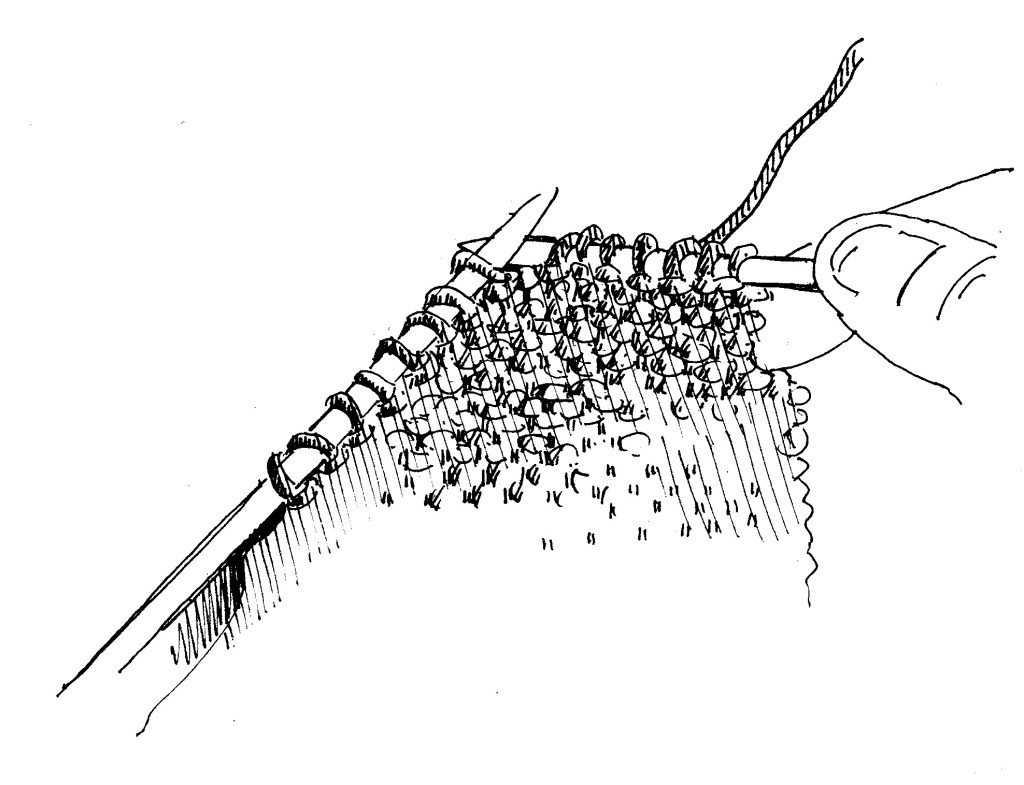
I learned to knit last fall. The whole idea appealed to me. The color and texture of the yarn and the needles, the gifts I could make for people, stitch by stitch, to make them feel special. Once I was knitting, however, the whole process seemed very slow. More than that, it was altogether too quiet, too unassuming – dare I say too feminine? Surely, I should be multitasking in some way. I began to wonder if it was worth my time.
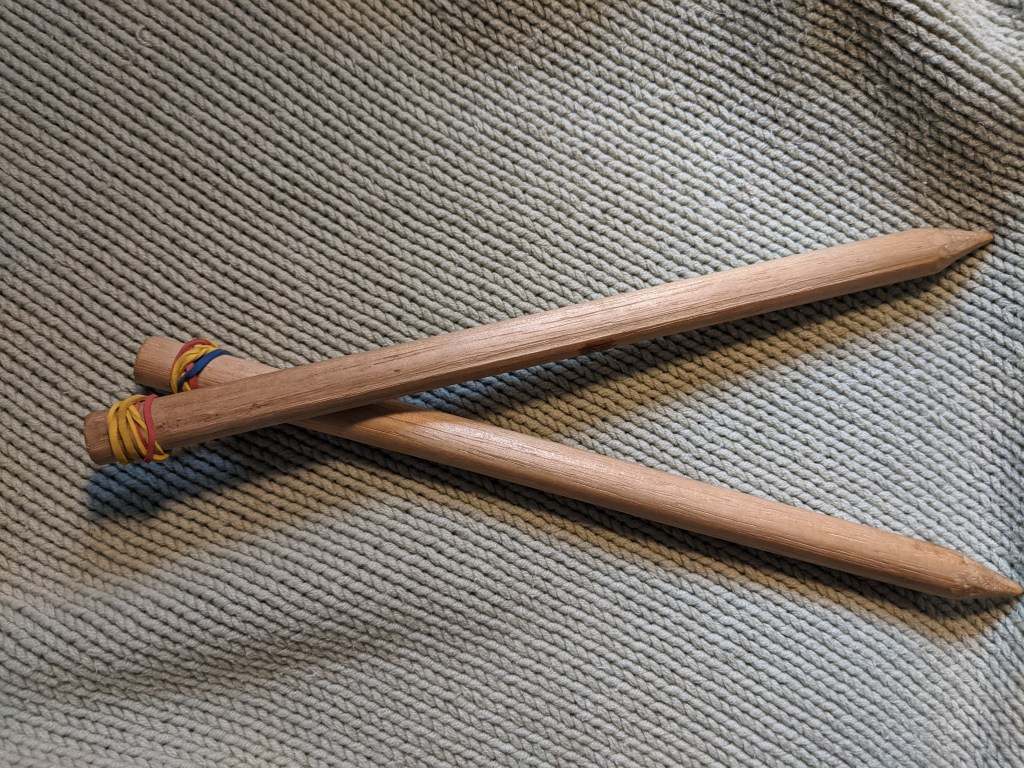
I could do pen and ink illustrations or write rambling essays on the knitting process. Then it would be worth the time. It became important not to spend any more than necessary on supplies. If time couldn’t be justified, then money ought not be either. I began to look at things in terms of their facility for knitting. Cotton newspaper cord makes a very unforgiving, dirt-catching dish cloth as it turns out. I ultimately settled on wooden dowels as needles (whittled at one end, a colorful tangle of rubber bands* standing sentry at the other) but not before the aforementioned blue ball points covered my hands in an irregular web of navy hatch marks.
That did it. Even I could see this was an absurd application for a perfectly good writing instrument. As is often the case, I had to reach into the ridiculous before taking a step back and realizing that one step back was a fine place to be after all. A friend in New Orleans used to say, “You know you’ve had enough when you’ve had too much.” He may have been referring to alcohol, but there’s a universal appeal.
Our whole culture seems to be going through, in macrocosm, what I went through in my little knitting microcosm. We are obsessed with speed, with productivity. We’ve been obsessed with it since the Industrial Revolution. Each new tool in the quest of speed has been greedily adopted before we realize what we’ve lost. When automobiles came out at the turn of the century (the earlier one), it didn’t take long for people to adapt to their speed. Now we demand it. Walking to the store seems imponderably slow. The early computers were thought to have unimaginably complex computing power. Now we use systems a hundred times more complex to log our gym schedules. We demand it. If we don’t have a cell phone, many of us feel the same sense of disconnection that our grandparents only felt in the event of a natural disaster. We might want to rethink our demands.
In fact, there are groups in Europe and America trying to do just that. The Slow Food movement began as an attempt to regain some of the pleasures of shared cooking and communal meals. The health benefits of eating at a relaxed pace are well documented. Many of us find it difficult to sit still long enough to have a really relaxed, robust conversation without the excuse of a major holiday. I find myself inordinately grateful for, if nothing else, the name of the European group which meets annually to promote a slower, more intentional life through city planning among other means: The Society for the Deceleration of Time (www.zeitverein.com). Some related websites are interesting: slothclub.org (Japan), longnow.org, simpleliving.net, newurbanism.org & superslow.com (US), slowhealing.com (UK) and slowfood.com (Italy).
I don’t doubt that these organizations do good work, but do we need movements and societies to do so? It strikes me as symptomatic of our desire if not to be super-efficient, at least to be special, that we make elaborate plans to design entire communities to encourage walking when we could simply call our neighbor and ask if they’d like to walk to the store. How much more special we feel if we create movements replete with motivational slogans and propaganda posters. It is possible that in not trying to be special at all, the more effective we become. It feels almost un-American to suggest such a thing. Just think of how hard it is to appreciate the child hamming it up in the school play and how much easier it is to appreciate the child quietly executing their role with skill.
Just take a walk, learn to knit, cook from scratch when you can. Spiritual people all over the world have been talking about this for centuries. ‘Be here now’ and ‘pray without ceasing’ strike me as being located somewhere on the same continuum. These encouragements at least have the value of being old enough so as to almost blend into the fabric of everyday life.
It’s no coincidence that it’s easier to work, think, write, paint and even to heal when there’s nothing of moment going on in the background. The everyday. Doing things in their own time, every day. It sounds relaxing, almost natural. If we insist on doing three things at once we run the risk of doing them without the satisfaction of having done one thing well. Doing a thing well is worth the time and in fact can have ancillary benefits.
Knitting has now come to have a meditative quality to it. The sharp demands of the outer world gradually swirl together into indistinct formless sensations which pale in the face of the blessedly simple pattern appearing with each click of the needles in my lap. Most knitters probably had this sense at the outset. Some of us think too hard. All of this and I know only the simple knitting stitch. I worry what will happen if I learn to purl.
*Thanks to Carol and Marilyn
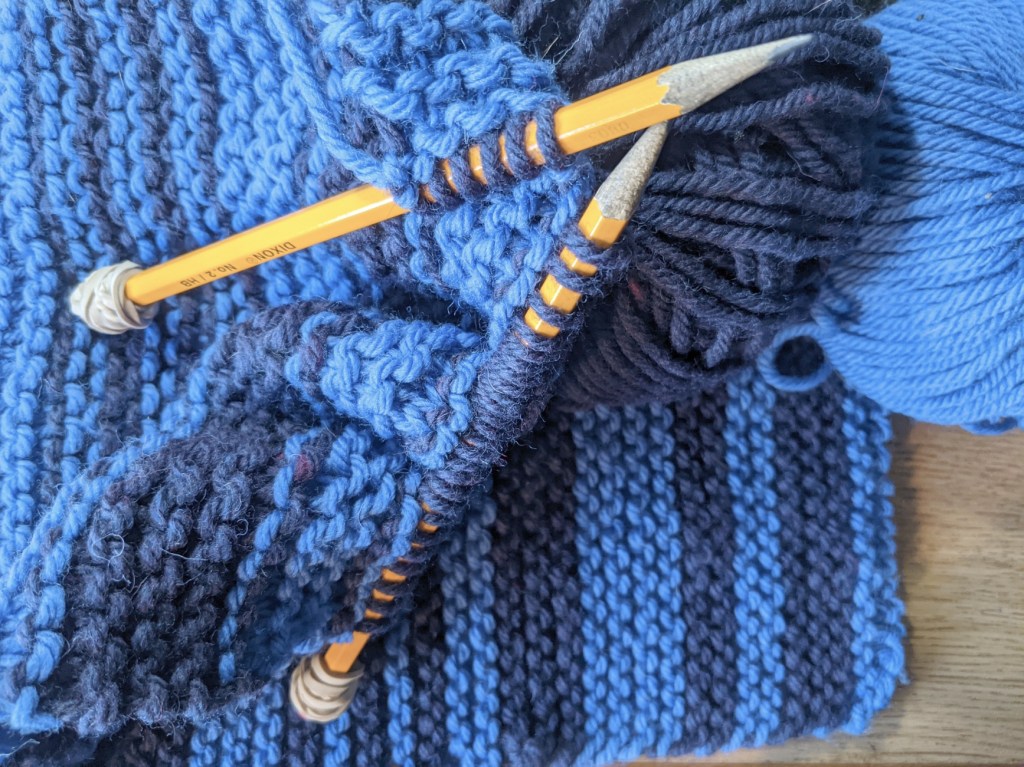
This was originally published in the March 2005 WNC Woman. I’ve just started trying to knit again and am optimistic about my new friend, Purl. Impatient to knit a small project, I finished it before buying more needles. The pencils still worked fine.
 these fine collapses @ desmonddahm.com