Imagine you’re a fisherman living on the banks of the Nile. You don’t yet know it, but your catch has made the Pharaoh and his family ill. In the middle of the night you wake to sounds of your reed-built shack being ransacked. You freeze at the glint of light in the shape of the horned helmet of a temple guard. As if it would actually help, you hope he won’t catch your eye.
But he does.
You start, trip on your rough blanket and miss the stunned expression on the guard’s face. A millisecond later, you slowly materialize, stumbling into the middle of a circle of monumentally stoned 19-year-olds at a Black Keys concert on the great lawn in Central Park in 2012.
And there you have it, a perfect set-up. Implausible juxtapositions just hang in the fun-filled air.
Time travel stories must be a blast to write. Maybe this is why it’s such a popular premise in novels and films. We enjoy the ride even though we know it’s not real. In our world, people don’t suddenly appear from another world or time. That would be crazy.
But there was that one time a man walked out of the stone age and into a town in Northern California in 1911. That was real.
A phone call was made to the sheriff about a small, thin man huddled against a corral fence, naked but for a ragged piece of canvas from a covered wagon draped over his shoulders. The local police didn’t know what to do with him, so he was put in a jail cell reserved for the insane.

Experts in native languages were summoned in an attempt to communicate. No one had any success. Soon, the sheriff was beginning to wonder what he would do with this wild man.
Then a telegram arrived from an anthropology professor, Alfred Kroeber, from the University of California.
“Hold Indian till arrival Professor State University who will take charge and be responsible for him.”
Ishi in Two Worlds, Theodora Kroeber, 1961, p. 6.
Kroeber’s colleague, T. Waterman, with some knowledge of native tribes in the area, was en route. Waterman painstakingly read from a list of North and Central native words, watching for any response from the wild man.
Finally, after a spirited discussion, each man pounding on the pine cot they were sitting on, the two were in firm agreement that siwini meant yellow pine. After more discussion, the native man asked, “I ne ma Yahi?’ to which Waterman replied that, yes, he was an Indian. A friend.
A receipt was drawn up and signed, transferring this man, the sole surviving member of the stone age Yahi tribe, into the care of the University of Anthropology in San Francisco.
‘Ishi’ means ‘man’ in Yahi and he gave this as his name to the caretakers who became his friends.
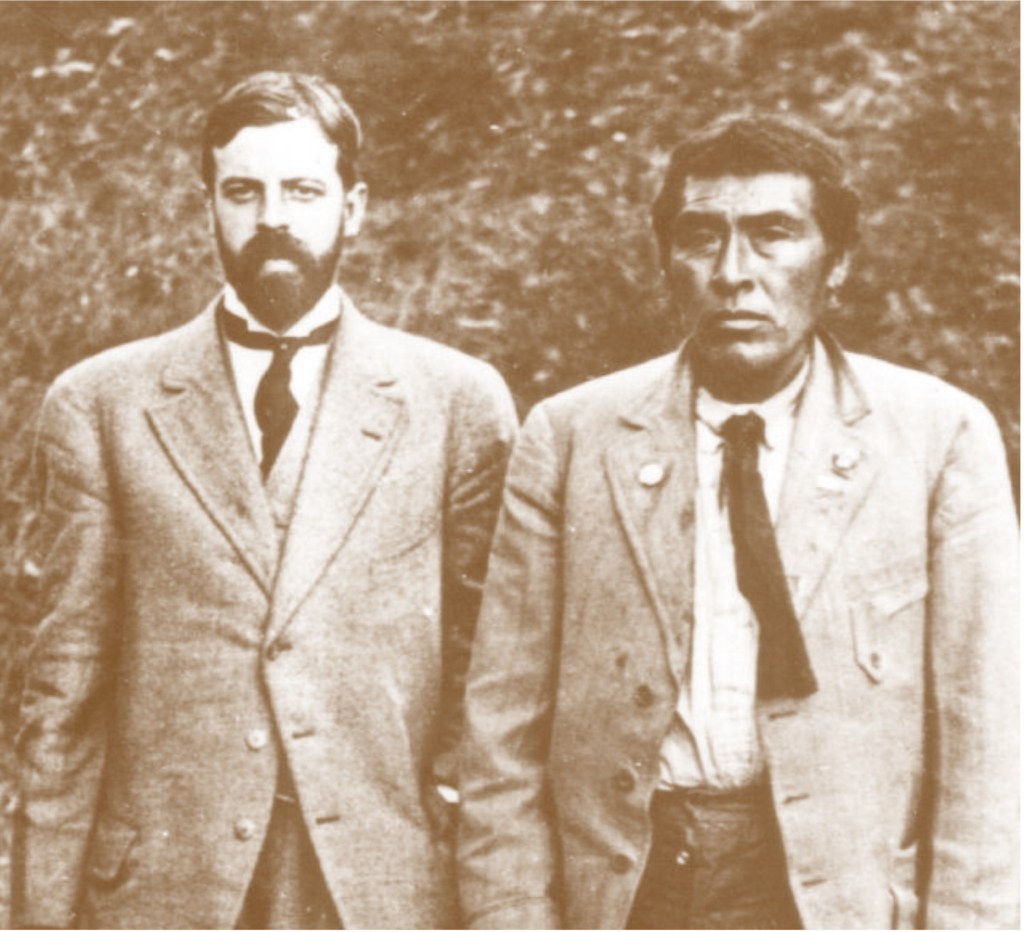
The Watermans and Kroebers were friends with Ishi until he died a short four years after his entry into the modern world. Theodora Kroeber, an anthropologist and wife of Alfred, wrote a fascinating book on the subject. It is a rich, not unalloyed, story.
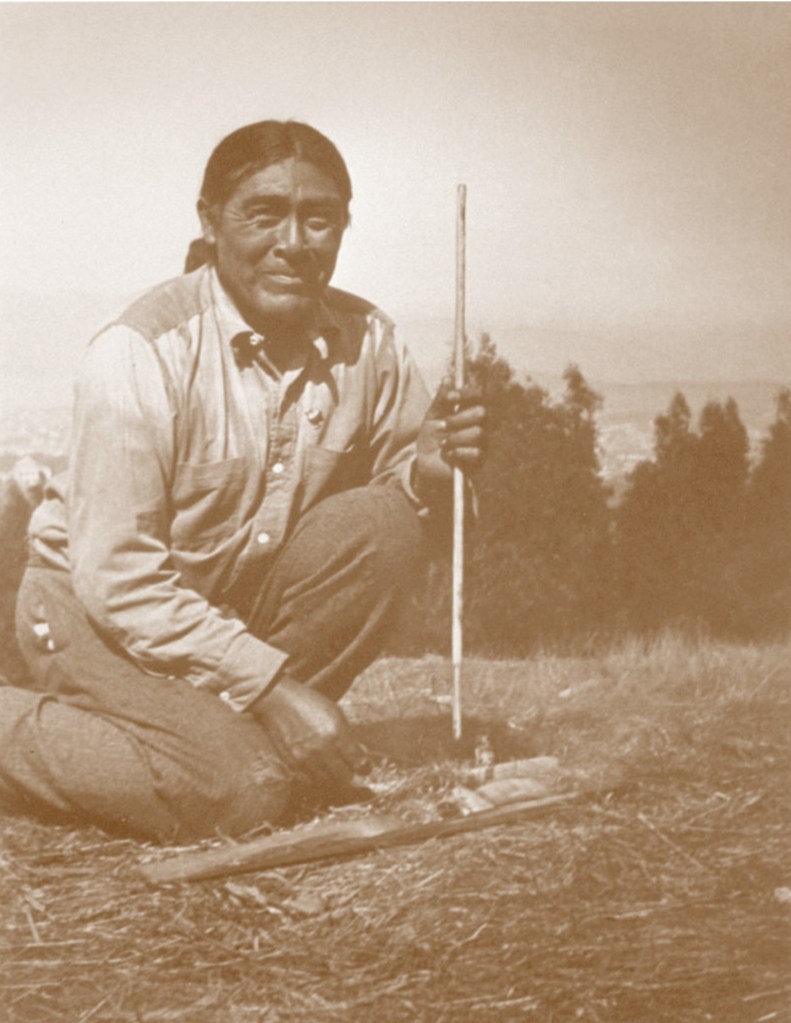
One interesting fact is that, though we had collected arrowheads and some of the tools of life in the stone age, until Ishi arrived, no one had ever been around to show the 20th century just how these tools were properly used.
Sometime after this, the Kroebers had children. One of their children, a daughter, was named Ursula. When she grew up, she married a man named LeGuin.
That Ursula LeGuin went on to posit some of the most perceptive, singular cultures in the worlds of her novels may have nothing at all to do with having grown up in a home where such a thing happened. Or, maybe it did.
What must it have been like to grow up in a family which had sheltered and befriended this man, essentially an alien from a world no one believed still existed? Algebra and kickball must have seemed thin soup.
While there is no way to calculate just what the experience brought to their parenting, it’s fairly evident that the Kroebers managed not to squash their children’s little psyches like bugs. And, isn’t that the least every child deserves?
It’s not initially obvious, as a parent, that what you don’t do is often as important as what you do. How wonderful would it be if every child grew up in a loving environment where, given the mastering of shoes, in theory anything is possible?
Children need to be free to play, to read and to think so they might learn to challenge what the adults in the room present as reality. Later, they may conceive of things their parents never dreamt.
Maybe it would be more useful to teach children to work the system, to influence, maneuver or charm in order to get what they want, but what a waste. Raising children with only an eye to the main chance would be like teaching a butterfly larva it can only make it as a caterpillar. The best bet is to keep wrapped up in that sack because that sack is a sure thing.
Just last year, at least one media outlet decried that our children may be learning how to be fair in schools. To pitch fairness as something to be avoided is absurd at best.
The world will always be available to teach us to look to our own ends. The problems we have will not be solved by focusing on individual success. Finding alternative means to support the people in the world without destroying either the people or the world will require thinking outside of the box, way outside.
And the box is looking pretty shabby lately.
“Strike a glass, and it will not endure an instant; simply do not strike it, and it will endure a thousand years.”
from The Ethics of Elfland, by Chesterton
What if we somehow never lost childhood’s fluency to make unexpected connections, to float possibilities on the surface of doubt? When did we first look at an oil slick and forget that it was beautiful?

What if the most important thing we can teach children is that they are enough? That they can relax and just be, play, think exactly the way that they do and not the way we do.
How is it that we need a state license to verify that we know how to drive a vehicle but we’re allowed to fall into parenting a small human with no training whatsoever? It seems like parents should be required, somewhere along the line, to swear, even if only to themselves, to do as little harm as possible.
Parenting 101: Be kind. Listen. Apologize when you’re wrong. Try your best. Remember, the odds are good they will be smarter than you are. Just don’t mess it up.
Don’t wrap them around your expectations so they end up growing like a sapling twisting through a chain-link fence the exact shape of your own insecurities.
You don’t need to teach a child to wonder, but wouldn’t it be great if wonder was treated with the respect it deserves. Isn’t it an inalienable right? A Freedom of Wonder. We have a mechanism to protect other rights, with language at the ready.
Congress shall make no law respecting an establishment of wonder,
or prohibiting the free exercise thereof.
Parenting is a skill we don’t outgrow simply because our children themselves are grown. And it is in no way impossible to parent without children. There are many, many people who use the exact same skill set to make the world around them a better place. Consideration, love and respect are essential skills at any time of life.
Not everyone will grow up to be Ursula LeGuin, of course not. That she had some success and her name is somewhat well known is less important than the fact that she took her own experiences and turned them into something truly her own. Paradoxical, that the more individually honest a story, the more it resonates with others.
It is not enough that children succeed. If they’re truly fortunate, they grow up to be exactly and robustly who they are. That would be enough.
 these fine collapses @ desmonddahm.com