I just finished reading a novel for the first time in a while.
Following a daring young woman in Churchill’s SOE, through a maze of clues, set-backs and close-calls, it was unusually satisfying when the author led me to an ending, good and true. I expect that’s because it’s less of a given, lately, that things will come out right or that people in charge will lead us to anything good and true.
Watching the social contract disintegrate in slow motion is exhausting. It feels like the new national hobby is watching people parade around in the foreground acting on impulses they used to be able to control. Where is study hall when you need it?
If this is a test, America, there are a few things we need to write on our collective arms: Other people and their needs are real. We can disagree without anger. And things are almost never as simple as they seem.
Calling reps, signing petitions, attending protests, helping candidates and voting are all so important that it feels wrong to stop, even for a little. We need some down time, but we also need to step up and help save the country.
I think there’s a way we can do both.
We can read.
In traditional Hindu culture, fairy tales were actually prescribed to people with psychological troubles. A patient was asked to meditate on a specific story in order to see a way through to health.
Reading stories, we flex our empathy ‘muscles.’ Spend a dozen hours with fictional people and you may actually care what happens to them. Unlike television or film, reading is more of a collaborative effort because we use our own experience to illustrate the authors’ words.
Twists and sub plots help to remind us that things are often not simple and that the hero is not the only person who matters. If you read a few mysteries, you end up skeptical of obvious answers and wonder what the other characters might be thinking. If fictional people become more real to us, maybe the people on the next block will too.
And a good non-fiction book can make you feel part of a larger story. It can be calming to step back from issues staring us in the face to consider the lives of people long ago, colonies of ants in Brazil or the neurons in our own brain. Reading about how problems arose, how they were solved and even how they failed to be solved gives us tools we might use in our own situation.
I work in a large public library. Most of what I check out to patrons are novels, then history and other non-fiction books. Rarely does anyone bring up a book of essays. Essays are one of the library’s well-kept secrets. I wish they weren’t because there is a lot to like in the form. They’re generally not too long. They’re often idiosyncratic, like visiting an eccentric interesting relative. Most importantly, for me, essays are generally about ideas.
It gets old, doesn’t it, thinking only about what the people around you say, what you watch on television or which emoji to release in response to the next callous thing some weasel in Washington does? It can feel like a tiny vacation to forget yourself for a while and follow an idea lovingly presented in an essay.
I stumbled onto the Penguin Great Ideas series recently and have been enjoying these very short books when I can find them. Many if not most libraries offer inter-library loans, a way for patrons to borrow books outside of the system for a small fee.
The page linked above lists the titles of the essays themselves, many of which are online. Two of the most amazing sites full of content in the public domain I’ve found are project gutenberg and hathi trust.
There are rafts of great essays not in the Penguin set. Did you know George Orwell, of all people, wrote an essay on how to make a proper cup of tea? And, while I can’t claim to always keep up with Christopher Hitchens, it’s great fun to watch him toss a thought in the air on page 17 then scramble through to catch it when it comes down on page 50.
I’ve read that the value to your brain of trying or succeeding at a new puzzle are the same. Fair play is so reassuring, especially lately.
There is an anecdote I love that when a very young George MacDonald, the Scots clergyman then author, first learned of the doctrine of predestination from his father, he burst into tears and was inconsolable. In David Elginbrod, one of his early novels, a little boy has just heard that God chooses only certain people for salvation. “Harry started up suddenly, saying: ‘I don’t want God to love me, if he does not love everybody;’ and, bursting into tears, hurried out of the room” (gutenberg.org/cache/epub/2291/pg2291.txt).
If this passage is autobiographical, that MacDonald went on to love fairy tales and fantasy, creating other worlds of his own, seems a happy ending. When the outer world is noxious, if you have subjects that you love to think about or things you love to do, then you have other, more pleasant, ways to spend your time. These can build you up when the world gets you down.
A sweet member of my extended family once asked me, “How do you get ‘interests?’”
I told her to think about what she enjoyed. To find something she liked to read or think about and go for it. That she subsequently filled library shelves, once packed with classic books on history and architecture, with a large collection of true crime books and a popular video library, I’m ashamed to say I once used as a punchline. I was wrong.
The point is that you get to choose what you fill your head with. Whether it’s stanzas from the Lays of Ancient Rome, lines from Animaniacs reruns, or both, no one has the right to tell you that
To every man upon this earth
Death comes soon or late.
And how can man die better
Than facing fearful odds,
For the ashes of his fathers,
And the temples of his Gods. (Macaulay, stanza 27)
is better than
Call me Dottie, and you die!
Beauty and beholders, it’s up to you. We need to fill our heads with hope, not hate.
I used to wonder, when flying, about the airlines’ instructions to put on the oxygen mask that drops in front of you during an emergency before helping anyone else. Now I think they have it right.
It’s time, America.
We need an interior life that is more nuanced than who said what to whom, who is dancing with what celebrity and why we hate anyone anywhere. These things are not helping.
Read. Save yourself first so you can help your country.
Just wander around your library and pick up whatever you see in front of you that looks interesting. You may enjoy it and you may see you’re not alone.
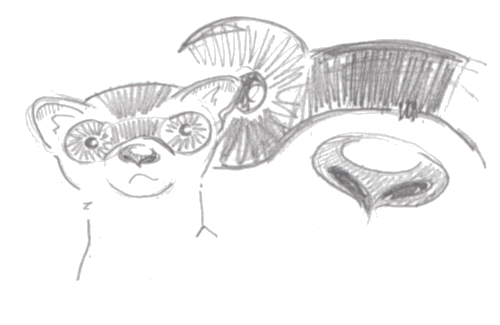
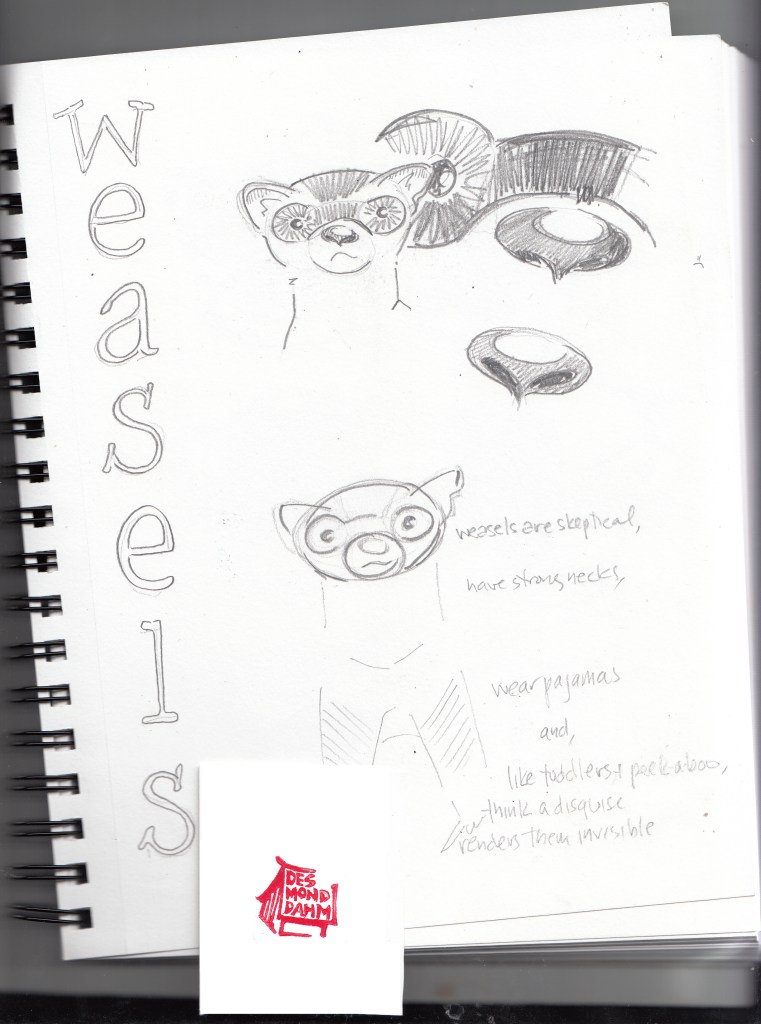
I just placed a hold on a book about weasels. I plan to fill my new sketchbook with notes on their habits and disguises — so I’ll be prepared. No, really, it’s because weasels are adorable and fun to draw. I’m aiming for 100.
Originally launched on medium.com
 these fine collapses @ desmonddahm.com
Hi Margaret, Happy New Year! I loved this essay so much. I have been forgetting to check your blog and was rewarded for doing so this morning with this weasel piece. Thank you for the inspiration. I hope 2020 starts out beautifully for you. Peggy W.
LikeLike